
Over the past three trading sessions, the stock of Cummins India has gained about nine per cent on strong January-March quarter (Q4) results and good near-term prospects. Its Q4 performance was led by a healthy 29 per cent revenue growth over the year ago quarter. This was largely on the back of a 33 per cent jump in domestic revenues while exports witnessed a growth of 17 per cent.

Reliance Industries (RIL) was the top-performing index stock on Friday (May 26) and closed the day with gains of 2.8 per cent, against a 1 per cent rise in the benchmark S&P BSE Sensex during the day. RIL's performance on the bourses on Friday was, however, an exception, and the stock has struggled to beat the broader market for nearly two years now. The company's share price is currently at the same level as in September 2021, while the benchmark index is up 6 per cent in the period.

Logistics services provider Delhivery posted a mixed set of results during the March quarter of the previous financial year (Q4 of FY23). While its operating profit was marginally in the green, its net losses widened as compared to the year-ago quarter. Overall revenues, which were in line with estimates, fell 10 per cent year-on-year (YoY).

The government is set to earn an equity dividend of nearly Rs 13,800 crore from the listed public-sector banks (PSBs), all 12 of them, for FY23, up 50 per cent from Rs 9,210 crore in FY22. This will be the highest ever dividend for the government from PSBs. The 12 PSBs in our sample are paying an equity dividend of nearly Rs 21,000 crore for FY23, up 53 per cent from Rs 13,710 crore for FY22.
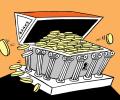
The banking sector emerged as an outlier when the rest of India Inc witnessed a slowdown in earnings in FY23. The combined net profit of listed public and private sector banks was up 39.4 per cent year-on-year (YoY) last financial year and their share in India's gross value added (GVA) or gross domestic product (GDP) at factor cost rose to a record high of nearly 1 per cent up, from 0.8 per cent a year ago. Listed banks' combined net profit grew to Rs 2.36 trillion in FY23, from Rs 1.69 trillion a year ago. In comparison, India GVA at current prices was up 15.2 per cent YoY at Rs 247 trillion in FY23; it was around Rs 214 trillion a year ago.

The 2022-23 (FY23) January-March quarter performance of the country's largest listed paint companies was better than Street expectations. Asian Paints, Berger Paints, and Kansai Nerolac Paints (Kansai Nerolac) registered double-digit revenue growth, compared with the year-ago quarter, reinforced by strong volume/value growth. Falling raw material prices also helped the paint majors hoist their gross margins.

Led by Tata Motors and Tata Consultancy Services (TCS), the combined revenue of the Tata group's listed firms crossed the Rs 10-trillion mark for the first time, in 2022-23. The group's 14 key listed companies in which Tata Sons holds a direct equity stake reported a combined revenue of Rs 10.07 trillion in FY23, up 15.3 per cent from Rs 8.73 trillion in FY22. The combined net profit of these companies was, however, down 10.6 per cent year-on-year (YoY) at Rs 66,670 crore in FY23, from a record high of Rs 74,540 crore in the previous financial year, when the profit had jumped 156 per cent YoY, aided by Tata Steel's strong showing.
The decline in LIC's share price makes it the biggest wealth destroyer among IPOs which hit the market after COVID-19 took hold globally in 2020.
The stock of Colgate-Palmolive (India) surged after the company delivered a better than expected operating performance for the March quarter of the 2022-23 financial year (Q4FY23) recently. The stock, however, has given up most of these gains over the last one week as the Street awaits recovery in the core toothpaste segment and sustained recovery in market share. The country's largest listed oral care company posted a gross margin expansion of 100 basis points (bps) on a sequential basis to 66.9 per cent, led by pricing and efficient sourcing.

Since its results, the stock of bottling and beverage distribution company Varun Beverages (VBL) is up 7 per cent on the back of a strong 2022-23 January-March quarter performance, robust outlook, and revision in profit estimates. Given the sharp uptick, it is now part of the trillion-rupee club, with its market capitalisation at Rs 1.01 trillion. The stock is one of the best performers in the consumer space as well as the S&P BSE 200, of which it is a constituent.

Thanks to a big payout by the group's cash cow, Tata Consultancy Services (TCS), Tata Sons is set to earn a record-high equity dividend worth nearly Rs 33,350 crore from the group's listed companies for FY23, up 130 per cent from Rs 14,529 crore in FY22. Nearly 90 per cent of this, or around Rs 30,500 crore, is estimated to accrue to Tata Sons while the rest will show up in its profit & loss account for FY24. This is because nearly 80 per cent of the dividend payout by TCS for FY23 was done before the end of the financial year through three quarterly interim instalments and a special one in January this year.

Tata Motors' 2022-23 (FY23) January-March quarter (fourth quarter, or Q4) results were better than Street estimates, with strong showing across Jaguar Land Rover (JLR), as well as commercial and passenger vehicle businesses in the domestic market. The company posted its highest consolidated top line and operating profit, with growth of 35 per cent and 46.5 per cent, respectively, over the year-ago quarter. While the top line was aided by a 49 per cent growth in the JLR unit, all key segments reported margin expansion.

The stock of two wheeler maker Eicher Motors was the highest gainer among BSE 100 stocks, rising 6.6 per cent in trade on Friday. The gains came on the back of better than expected performance in the March quarter of the 2022-23 financial year (Q4FY23) and earnings upgrades by brokerages. Standalone revenues (Royal Enfield) were up 19.9 per cent year-on-year (YoY), led by an 18 per cent growth in volumes and a marginal uptick in realisations.

The stock of India's largest agrochemical player - UPL (formerly United Phosphorus) - fell 2.8 per cent in trade. It was among the top losers in the BSE 100 on Tuesday. Weak 2022-23 (FY23) January-March quarter (fourth quarter, or Q4) performance and muted near-term outlook led to the decline. The company reported lacklustre growth in revenue of 4 per cent on the back of a price reduction of 3 per cent and volume growth of 1 per cent.

Corporate India continues to be generous in rewarding its shareholders with big dividend payouts. This is especially true for shareholders of companies such as Tata Consultancy Services (TCS), Hindustan Zinc (HZL), and Coal India (CIL) which are seen as cash cows of large business groups and the government. Boosted by a big payout by these three companies, the combined equity dividend payout by listed companies was up 38 per cent year-on-year (YoY) to a record high of Rs 2.27 trillion in 2022-23 (FY23), compared with Rs 1.65 trillion in 2021-22 (FY22).
Vedanta Limited (Vedanta) helping its parent and group holding company Vedanta Resources to deleverage its balance sheet has started to strain its balance sheet. Vedanta's gross debt (consolidated) was up 24.3 per cent year-on-year (YoY) in FY23 and reached a six-year high of Rs 66,628 crore by the end of March. Similarly, its net debt went up 20.3 per cent YoY to Rs 45,706 crore at the end of FY23, up from Rs 38,228 crore a year ago; it was the highest since FY20.

India's largest two-wheeler maker by volume - Hero MotoCorp (Hero) - posted a better-than-expected operating performance in the January-March (fourth quarter, or Q4) quarter of 2022-23 (FY23). Riding on higher average selling prices which were up 5 per cent year-on-year (YoY) and volume growth of 7 per cent, the company registered a 12 per cent growth in revenue to Rs 8,306 crore. The company sold 127,000 units in the quarter, largely driven by domestic sales which were up 11.6 per cent, while exports saw a sharp fall of 57 per cent over the year-ago quarter.

Titan posted better than expected revenue growth in the March quarter of the financial year 2022-23 (Q4FY23), powered by strong demand trends in the jewellery and watch segment. Standalone jewellery sales for the firm were up 24 per cent year-on-year (YoY) on a slightly lower base and aided by like-to-like growth of 19 per cent. The company highlighted that new buyer growth was at 15 per cent while average ticket size was up 8 per cent.

The growing mismatch between Go First's losses and other group companies' profits was making it tough for the group to fund the losses of the airline venture.

The early bird results for the January-March quarter of 2022-23 (Q4FY23) show a pick-up in earnings growth, despite a slowdown in revenue growth, thanks to a decline in input costs and lower provisioning for bad loans by banks. The combined net profit of 66 companies that have, so far, declared their quarterly results was up 15.2 per cent year-on-year (YoY) in Q4FY23, an improvement from 4.3 per cent YoY growth in Q3. Net sales growth of these companies, however, slowed down to 11.5 per cent YoY in January-March 2023, the slowest rate in eight quarters.
 © 2026 Rediff.com - Advertise with us - Disclaimer - Privacy Policy - Sitemap - Feedback - About us - Terms of use - Grievances